Building the decision-making layer of the autonomous factory: Ten years of Flexciton
Ten years ago, a mathematician from Oxford and an engineer from Imperial College set out to apply optimisation to hard real-world problems.

A decade on, Flexciton's co-founders Jamie and Dennis have made mathematical optimisation work in live wafer fabs at production scale, and are shaping how the industry thinks about autonomous factory operations. To mark the company's 10th anniversary, we asked them both to reflect on the past decade and the one ahead.
Of all the industries you could have built a deep-tech business in, why semiconductor?
Jamie: Two things stood out for me. The first was technical fit. We were already experts in planning and scheduling, we'd done it elsewhere. Once I understood how planning and scheduling problems were being tackled in the semiconductor industry, and just how complex they are, the opportunity was obvious. The way things were being done left so much on the table. For a business built around deep technology and real innovation, this was a place we could genuinely make an impact.
The second was strategic. Semiconductors are one of the most important industries in the world, and they're facing serious challenges. Building something here meant we could have a meaningful impact on an industry that, in turn, shapes the rest of manufacturing.
Dennis: For me, it started with a love of hard problems. I'm an engineer at heart, and I've always been drawn to things that look intractable. We weren't fixed on semiconductors when we began; we were exploring manufacturing more broadly. The turning point was an opportunity to tackle the scheduling problem at Seagate. I came from a research background in optimisation for energy systems at Imperial College, oil and gas, solid oxide fuel cells, and knew nothing about chip manufacturing at first. The more I studied it, the more hooked I became. The sheer sophistication of the problem, the fact that there was no real solution to it, and how central the industry is to modern life, too exciting to walk away from.
What was the problem you set out to solve, and how has your thinking evolved?
Jamie: We started with shop floor scheduling. It was the obvious place to begin, WIP flow scheduling fundamentally dictates how much revenue a fab makes. You can see every wafer, and getting those wafers out of the door is the revenue.
But solving that problem revealed something I hadn't anticipated. A huge number of the inputs into WIP flow scheduling, when maintenance happens, how recipes are allocated to tools, are decided by other people elsewhere in the fab. Shop floor scheduling became a window into the wider planning landscape. It's not one problem; it's many, and they're all connected. Most of those decisions are still being made manually or with rules of thumb. There's a tremendous opportunity in optimising every one of them.
Dennis: If I zoom out from that, scheduling itself is really a subset of a much larger logistics and operations challenge. WIP flow management is the logistics of moving work through the factory. What's changed over ten years is the scope of our ambition. We think about the full decision-making pyramid now: scheduling at the bottom, multi-year capacity planning at the top, and everything in between. Integrating all those decisions so that a fab achieves true control and maximum efficiency remains an open problem. That's the one we're solving today, and it's what real autonomy in manufacturing actually requires.
Flexciton was the first to bring mathematical optimization to wafer fab scheduling at scale. What did it take to get there?
Jamie: Mathematical optimization has been discussed in academic literature for years as a way to solve manufacturing problems. But when we went to market, no one was actually using it in semiconductors. The reason is that the problem is enormous, the fab is incredibly dynamic, and you need answers in minutes. A tool that was up five minutes ago might be down now. The schedule has to react.
The innovation that took us years of R&D, and a fair amount of technical risk, was working out how to take live factory data, dynamically construct an optimization problem that represents the real fab, and solve it at scale in just a few minutes. That's the bit no one had cracked before. Several of our customers today had tried it themselves and couldn't make it work in practice. Seagate was the customer that proved the concept with us. They saw the potential from the initial proof of concept, then helped us deploy it in their facility. The KPI improvements were clear and measurable.
A trusted partner and a multidisciplinary team, that's the secret sauce. I can give it away freely, because knowing it doesn't make it any easier to copy. It just takes time. ~ Dennis Xenos
Dennis: The obvious answer everyone reaches for is the complexity, thousands of resources, hundreds of constraints, and enormous problem size. That's real, but it's not what I'd point to first. The bigger challenge was actually finding trusted partners like Seagate, willing to innovate and iterate with us for literally thousands of hours to mature the technology. That's now part of Flexciton's moat.
The second challenge was talent. We had to hire people with a rare blend of skills: optimisation, semiconductor and operations expertise, and software engineering, all at once. That kind of multidisciplinary capability is genuinely hard to assemble; it can take as long to build as it took us. So I'm happy to say it openly: a trusted partner and a multidisciplinary team, that's the secret sauce. I can give it away freely, because knowing it doesn't make it any easier to copy. It just takes time.
And once the technology worked, what about getting people to actually adopt it?
Jamie: Three layers to that. First, getting customers to try something new in a conservative industry. We got in because what we offered was demonstrably better than the status quo, and because some early adopters had tried this kind of technology themselves and understood the potential.
Second, getting the fab to use the software once it's installed. Optimisation makes decisions differently from how people made them before, and with an AI-type system, you can't always explain every decision. What we learned is that adoption isn't about explaining every decision, it's about giving people the controls to deliver the results they want and making it easy to see clearly that the results are better.
Adoption isn't about explaining every decision. It's about giving people the controls to deliver the results they want and making it easy to see clearly that the results are better. ~ Jamie Potter
Third, shop floor adoption. You can't have great optimisation in the background if the operator doesn't follow it. We built an operator UI that gives clear instructions and explains the reasoning, and adherence tracking, so we can see who's following the software and who isn't. None of this was obvious at the start. We've figured it out now.
How is Flexciton making a mark on the industry today?
Jamie: Our growth journey has been slow and then quick. For a long time, the questions we got were: Does this technology work? Can you deliver? Are you a credible team we can trust? Then the narrative flipped, and over the last few years, we've been growing significantly. Today, “does this actually work?” is a question we essentially don't get asked anymore.
Today, 'does this actually work?' is a question we essentially don't get asked anymore. ~ Jamie Potter
Part of the impact is the number of fabs we work with, global, front-end and back-end. Another part is the breadth of problems we're solving: we started with shop floor scheduling and have branched into capacity planning, maintenance planning, starts planning and beyond. But the biggest shift is at the industry level. Increasingly, we're shaping the narrative on what an autonomous factory actually looks like, through industry working groups, and through our SmartFab community, where fabs come together to share what's working. The impact isn't just our products with our customers; it's helping the whole industry get to where it needs to go.
Dennis: For a long time, people said building autonomous, dynamic scheduling was extremely hard, even impossible. I'll admit I was in that camp myself, back in my academic years. So it means a lot that we've now set the bar at a very different place. Today, we're running autonomous scheduling and planning solutions in a closed loop, fed in real time by factory systems, with almost no human intervention. People step in only by exception. That's the blueprint, and it's the one we'll replicate at increasing scale. There are still many fabs out there relying on tools that depend on manual intervention, because that manual approach was never going to scale. Showing the industry it doesn't have to be that way is, I think, our real mark.
Looking ahead at the next ten years, where is the industry going, and what role will Flexciton play?
Jamie: Ten years is an interesting time frame. The industry is conservative and doesn't adopt new technologies quickly unless there's a real need. The biggest driver I'm seeing for autonomy is the shortage of skilled labour, and it's getting worse year on year. As that pressure builds, it might push us all to move much faster than we'd expected. It's genuinely possible that within ten years we'll see truly autonomous factories.
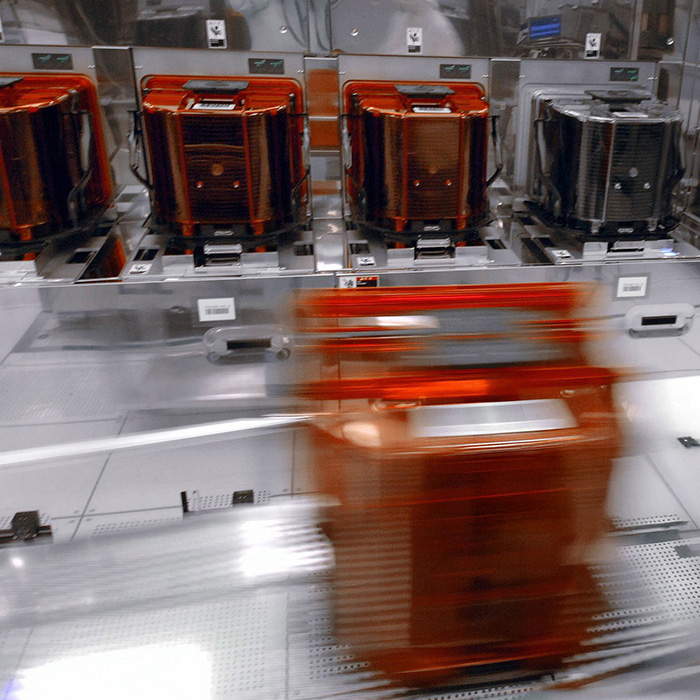
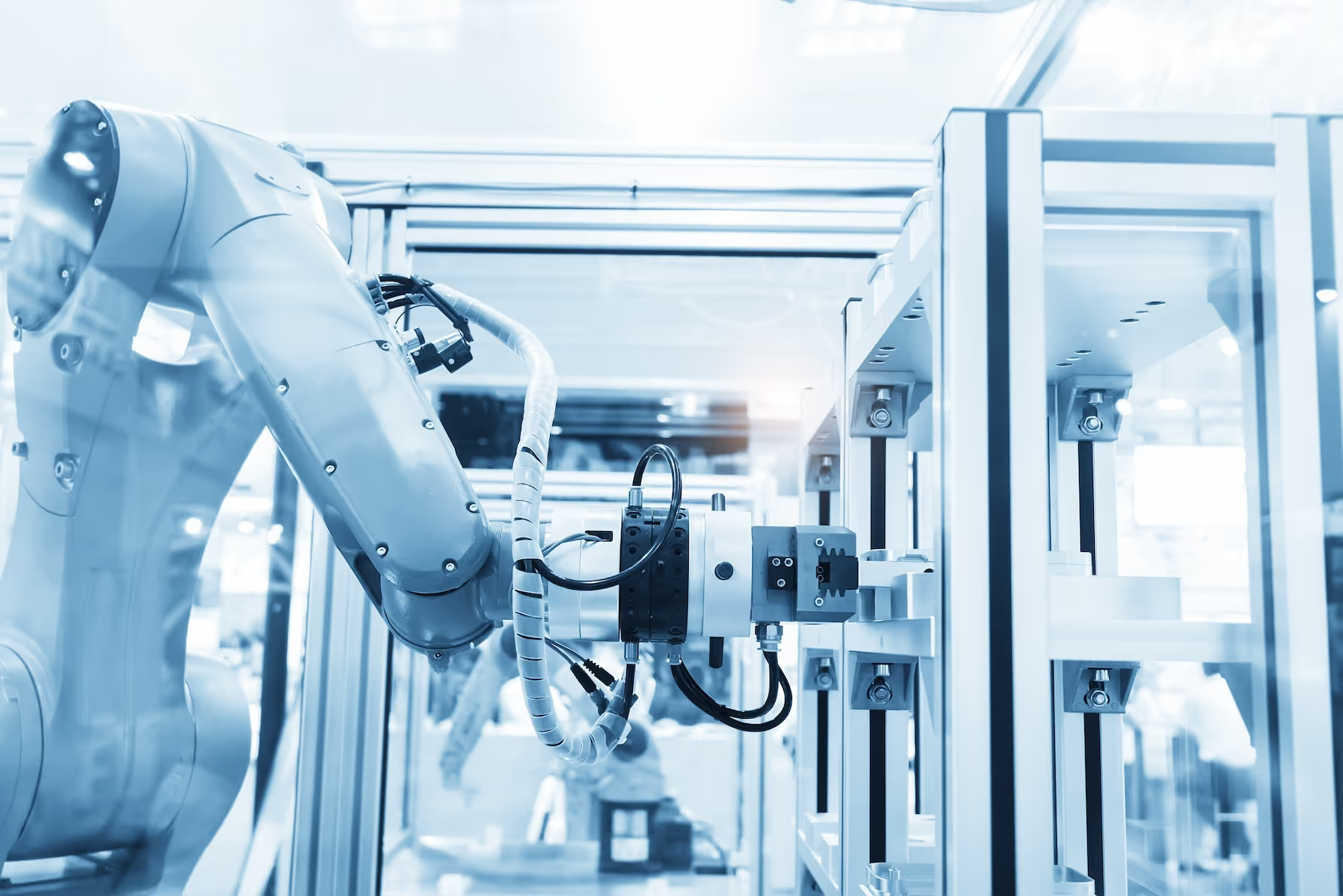
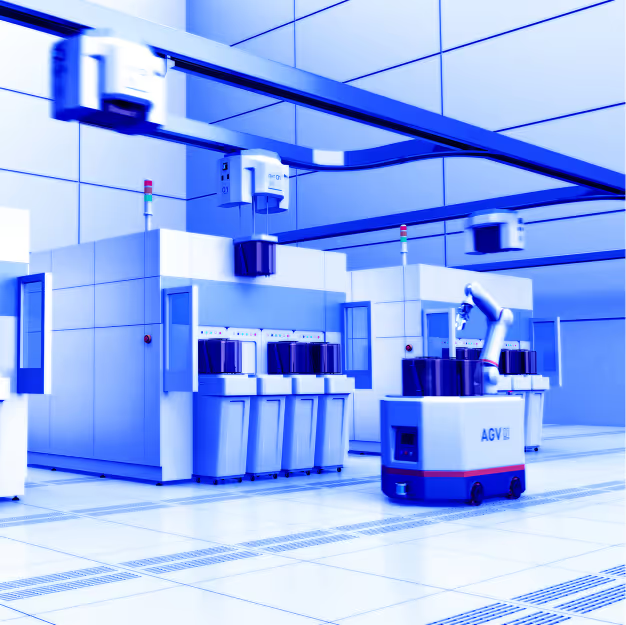
There are a lot of components to get there. The right data systems via MES. The right decision-making layer, the space Flexciton sits in. And the right robotics on the floor: AMHS, AMRs taking on what used to be a two-person job in 200mm fabs, and increasingly autonomous maintenance, where robots maintain tools instead of technicians. Our role is going to be that decision-making layer. We won't be building the MES or the robots ourselves, this is a collaborative effort, and part of our role is helping set the direction of how data systems, decision-making and robotics come together to make autonomy real.
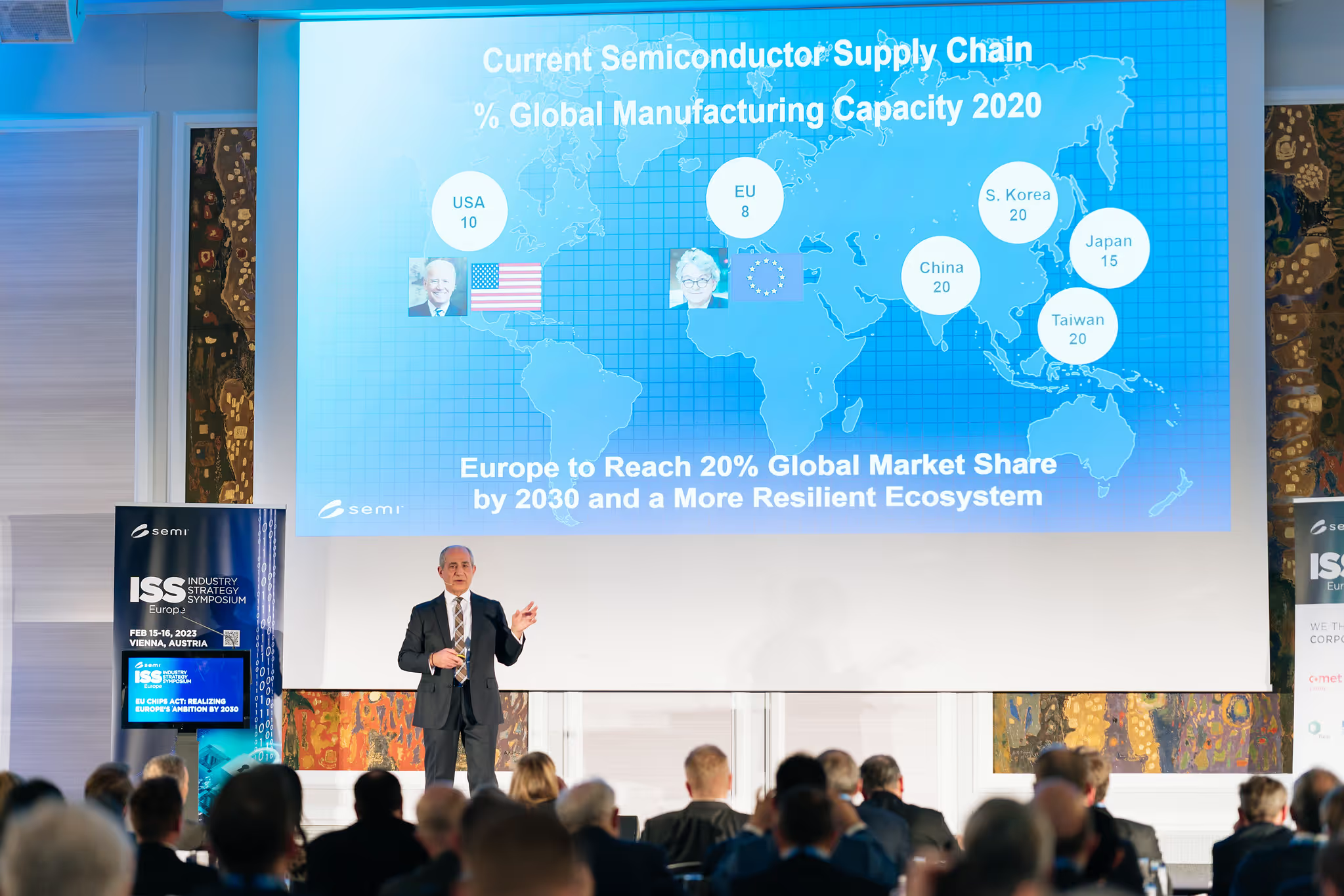
Dennis: I'm co-leading the SEMI working group on Automation and Autonomy, and we're designing frameworks for exactly this. My prediction is that the majority of fabs will become fully autonomous. The cost of automation software, the time it takes to deliver, and the cost of robotics will all drop significantly, opening the door for far more factories to invest. Two forces will push hard: the talent shortage, something like a 100,000-position gap expected over the next four years, and cost pressure, with US and European fabs running at one to three times the cost of their Asian counterparts. Together, those will drive a wave of automation.
Autonomous decision-making is the enabler, and in many cases the prerequisite, for full autonomy. You can't install robotics and expect a fab to run without human intervention if the underlying systems aren't integrated and optimally run. ~ Dennis Xenos
Flexciton has a critical role to play here. Autonomous decision-making is the enabler, and in many cases the prerequisite, for full autonomy. You can't install robotics and expect a fab to run without human intervention if the underlying systems aren't integrated and optimally run. That integration is the hard part, and it's exactly where we come in.
And what's the role of AI in all of this?
Jamie: “AI” covers a lot of different technologies in practice. Generative AI is getting most of the hype right now, and what's remarkable about it is that it can replicate things humans used to do, particularly reading and writing text. We'll see a lot of those tasks automated.
But there's another kind of AI, the kind Flexciton builds, that doesn't replicate what people did. It optimises decisions in ways and at a scale that people never could. That's the space we operate in. And it has to be complementary: good AI needs good data coming in, and it has to work with robotics. A robot can move a wafer from A to B, but something has to decide what to move, when, and by which robot. That decision layer is the AI brain of the factory, and that's the part we're building.
Looking back at ten years, what does this journey actually teach you?
Jamie: What I've realised is that building something meaningful in this industry takes a long time. No impactful semiconductor company out there was built in ten years. They're built in twenty, because of how long it takes to get to market, build credibility, make your solutions work, and get the real insight you need.
Looking back at the last ten years, we've been through an incredible journey. And looking ahead, I think the next ten will be exponentially more impactful than the last. The way the market accepts us and what we do now, we have the platform to make a tremendous impact. Combined with the clear megatrend towards the autonomous factory and our unique position in it, it's a hugely exciting time to be doing what we're doing.
The next ten will be exponentially more impactful than the last.~ Jamie Potter
To keep up with what comes next, follow us on Linkedin and subscribe to the Flexciton newsletter at the bottom of the page.
More resources
Stay up to date with our latest publications.




.avif)
.avif)





















.avif)











Speak to one of our experts
Book a demo session or simply reach out to one of our experts to learn more about what Autonomous Technology could do for your fab.